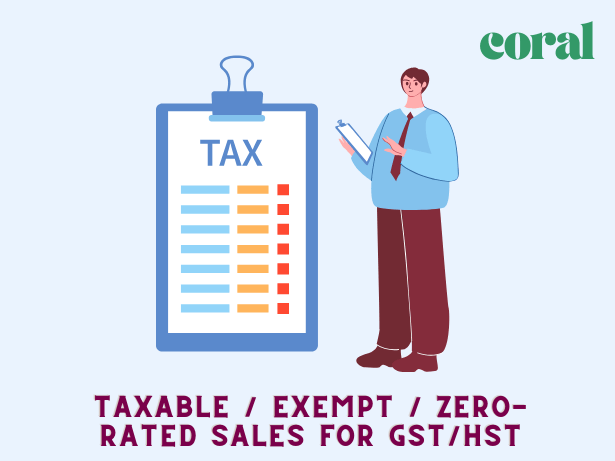
Confused about taxable, exempt, and zero-rated sales on your GST/HST return? This guide explains the difference, what goes on Line 101 and Line 103, and how each category affects your input tax credits (ITCs).
If you’re incorporated and registered for GST/HST, classifying your sales correctly affects:
The confusing part: zero-rated sales are taxable (just at 0%). Exempt sales are not taxable. CRA treats them very differently.
A taxable supply is a sale made in the course of a commercial activity that is subject to GST/HST - this includes zero-rated sales too.
Zero-rated supplies are taxable, but the rate is 0%.
CRA examples include basic groceries, prescription drugs, certain medical devices, and many exports.
Exempt supplies are not subject to GST/HST.
Common exempt examples include long-term residential rent and the sale of housing last used as a personal residence (among others).
Here’s the key CRA rule that surprises many owners:
Line 101 (“total sales and other revenue”) includes your revenue from supplies of property and services, including zero-rated and exempt supplies, plus other revenue for the reporting period (and you don’t include GST/HST itself under the regular method).
So Line 101 is not “taxable sales only.” It’s basically your gross revenue reporting line for GST/HST purposes.
Line 103 is the GST/HST you collected (or were required to collect) on your taxable supplies.
That’s why it’s normal for Line 101 and Line 103 to look “unrelated.”
Supporting CRA references: definitions and examples of zero-rated and exempt supplies, and ITC eligibility rules.
ITCs (input tax credits) are how registrants recover GST/HST paid on expenses used in their commercial activities.
If your business has both:
you may have to apportion (split) your ITCs and only claim the commercial portion. CRA explicitly notes you may need to apportion when you have exempt supplies.
Common example:
You’re a corporation that earns:
Shared costs like rent, software, phone, and accounting fees may need an ITC split if they support both revenue streams.
CRA return instructions for Line 101 and Line 103 (regular method) and ITC overview.
If you file using the Quick Method, CRA’s instructions for Line 101 differ (it generally includes GST/HST in the Line 101 total for that method). Don’t mix the regular-method habit with quick-method reporting.
Many exports are zero-rated (taxable at 0%), not exempt—meaning ITCs may still be available if conditions are met. Export rules can be detailed, especially for services and intangible property.
Long-term residential rent is commonly exempt, while commercial rent is generally taxable. If you have both, your ITCs may need to be split.
If your accounting system only has “Sales” without tax-status categories, you’ll end up guessing at filing time—which is when misclassifications happen.
Fix: set up separate income accounts (or tax codes) such as:
For most businesses, the small supplier threshold is based on taxable supplies (including zero-rated)—not exempt supplies. CRA’s registration guidance also distinguishes taxable (including zero-rated) from exempt when determining “total annual revenue” for GST/HST registration purposes.
Are zero-rated sales considered taxable sales?
Yes. Zero-rated supplies are taxable at 0%, meaning you don’t charge GST/HST, but they’re still taxable and can support ITCs.
Do exempt sales go on Line 101?
Yes. CRA says Line 101 includes revenue from supplies including zero-rated and exempt supplies.
Do zero-rated sales go on Line 101?
Yes—same reason.
Do exempt sales go on Line 103?
No. Line 103 is GST/HST collected or collectible. Exempt supplies aren’t subject to GST/HST.
If I only make exempt supplies, should I register for GST/HST?
Often no—because you generally can’t claim ITCs on exempt activities anyway, and you aren’t charging GST/HST. But specific situations can be nuanced; get advice if you’re mixing exempt and taxable lines.
Why is my ITC refund smaller than expected?
A common reason is that part of your business activity is exempt, so ITCs must be reduced to the commercial-use portion.
What if I charged GST/HST by mistake on an exempt item?
The customer may have paid tax they didn’t owe, and you may still have reporting/adjustment work to fix it. This is one of the reasons correct classification matters (and why we like clean tax codes in bookkeeping). (CRA’s rules vary by facts - handle carefully.)
Do exports always mean zero-rated?
Not always. Many exports are zero-rated, but the conditions and exceptions matter (especially for services and intangibles).
Which provinces use GST vs HST rates?
CRA lists the current GST/HST rates by province (including participating vs non-participating provinces).
Can Line 101 and Line 103 be totally different?
Yes. Line 101 includes exempt and zero-rated revenue; Line 103 only includes GST/HST collected or collectible.
On a GST/HST return, taxable, zero-rated, and exempt sales can all show up in Line 101, but only taxable (non-zero-rated) sales usually drive Line 103, and only taxable/zero-rated activity generally supports ITCs. If your books don’t clearly separate these categories, it’s easy to over-claim ITCs or misreport tax.
If you want, Coral CPA can review your revenue streams, set up clean GST/HST tax codes in your bookkeeping, and file or clean up past GST/HST returns so you’re claiming the right ITCs without triggering CRA issues.
Fill out this intake form to reach out to us.